
Thinking about home improvement? You will find that the traditional home improvement meaning doesn’t describe everything that can be improved in a home.
We love our homes but let’s be honest, they are not always what we would like them to be. That is where home improvement comes in, but what is home improvement?
Traditionally, the meaning of home improvement is tied to the condition of your physical house, but what if I told you that home improvement has a meaning that goes beyond improving your house alone?
Having done plenty of home improvement myself, I’ve discovered that the meaning of home improvement can stretch into many other parts of your life that operate within or around the confines of your house. It is the difference between home improvement and house improvement.
In this post, we will take a look at alternate ways we can improve the quality of our home, not just our house, to discover the true meaning of home improvement.
The Meaning Of Home Improvement
There is a difference between home improvement and house improvement. The term “house” is very specific, referring to a literal physical structure that people live in but the term “home” can be defined in various ways:
A home is a place where someone or something lives.
It can refer to physical structures like a house, a car, a beaver’s dam, an ant hill, or anything that is used as a means of shelter. Alternatively, it can also refer to a location like a city, country, or a specific area.
A home is a hub that is departed from and returned to.
In a personal sense, home is the place we leave and go experience life, it is also the place we come back to when we’ve had enough. In a business sense, it could mean the local branch that you are assigned to work from or the one central to your area of operations.
A home provides safety and security.
This refers to the expression “Home Is Where The Heart Is.” It can be your family or a group of friends or co-workers. It can be your parent’s house you grew up in or your first apartment you finally moved into after graduation.
Home can be so many things that defining it as only improving one’s house is a very shallow meaning indeed. Now that we know how broad the definition of “home” can be, let’s examine two alternatives that we can use to improve our home, not just our house.
Contents
Space
The first meaning of home that we can improve upon is the space we consider our own. This includes optimizing room layouts, how rooms are used, and, here is the kicker, how you feel about them.
Yes, you can improve your own home simply by changing your perspective of it.
Change of Perspective
How we see our surroundings can have a big impact on other things in our life and the great part about perspective is that we can always change it!
In this case, a change of perspective can help us see how large our homes are relative to how big they used to be.
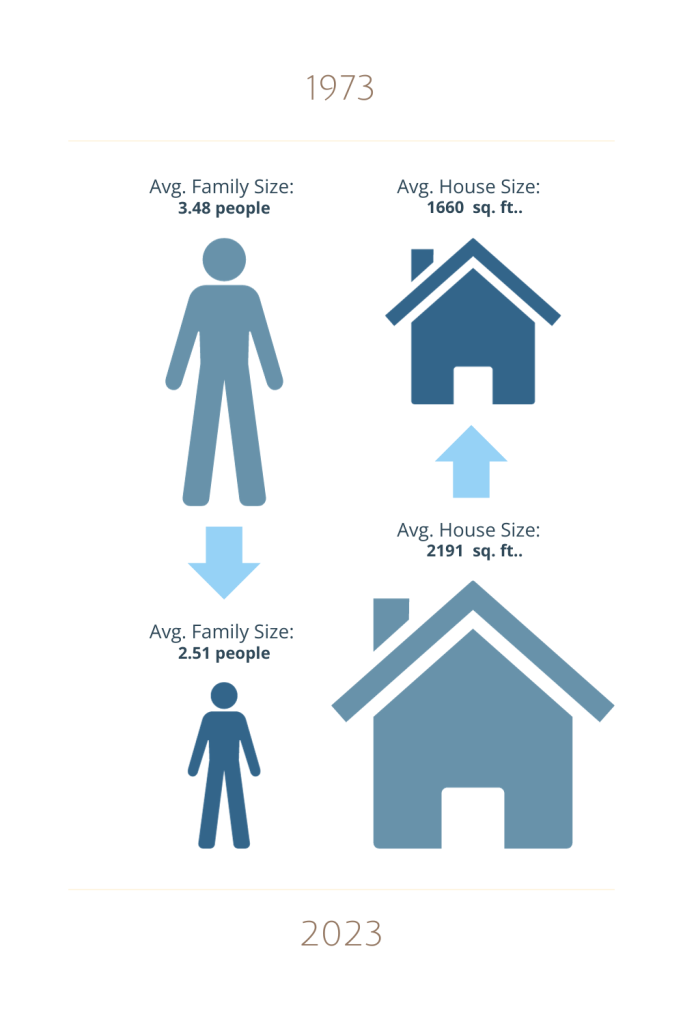
According to the U.S. Census Bureau, much larger families were living in much smaller homes in the past, the inverse being true today.
Take a second to think about what that would be like. Imagine living in an 800-square-foot ranch on the prairie with 8 other people and having to share it with everyone, every day!
I hate to say it, but all of your grandparents’ “when I was your age…” stories should make you question how much space we actually need.
It’s no wonder that trends like “tiny homes” exist and are growing more popular. (You don’t HAVE to live in a tiny home, just sayin’)
People have been surviving for thousands of years in teeny, often dangerous, living situations and Americans today could benefit from acknowledging that. If we can do that, we just might be able to look at life in these modestly sized homes with a fresh point of view.
After all, it could be much worse!
Prioritize Purpose
Another way to improve on our spatial definition of home is to scrutinize the purpose of your rooms.
As a quick exercise, try thinking of some typical house room names like:
- Dining Room
- Bathroom
- Bedroom
- Kitchen
- Study
What do they all have in common? They are all named after the intended purpose of the room! (except for the kitchen but you still likely know what it’s for)
You dine (eat) in the dining room, bathe in the bathroom, sleep (in a bed) in the bedroom, etc.
I am no interior design major, but one of the key things I learned from my own research is that the purpose of a room should be well thought out to maximize its usefulness.
 TIP: No one room needs to be limited to one purpose, we can combine room functionality to make multipurpose rooms.
Some examples:
- Add a TV to a formal living room and make it a family room
- Put down rubber flooring in a storage room and make it a storage gym
- Move a desk into the bedroom and make it an office with a break room
There are so many ways to combine rooms, just decide what activities you want to accommodate and start experimenting.
This is not to say that you should never look at your rooms with an eye for aesthetic design but you should probably address your basic needs first before addressing the superficial ones. (thanks Maslow)
Design For Flow
The last thing to address in our spatial home improvement meaning is related to room layout. Once you have established the purpose of your rooms you can then establish how they should flow.
The “flow” of a room describes how easy it is to get from one part of the room to another. It can also refer to the ease of transition between rooms or spaces.
The better the flow is, the easier it is to move around the house and that can have a huge impact on how big your home looks and feels!
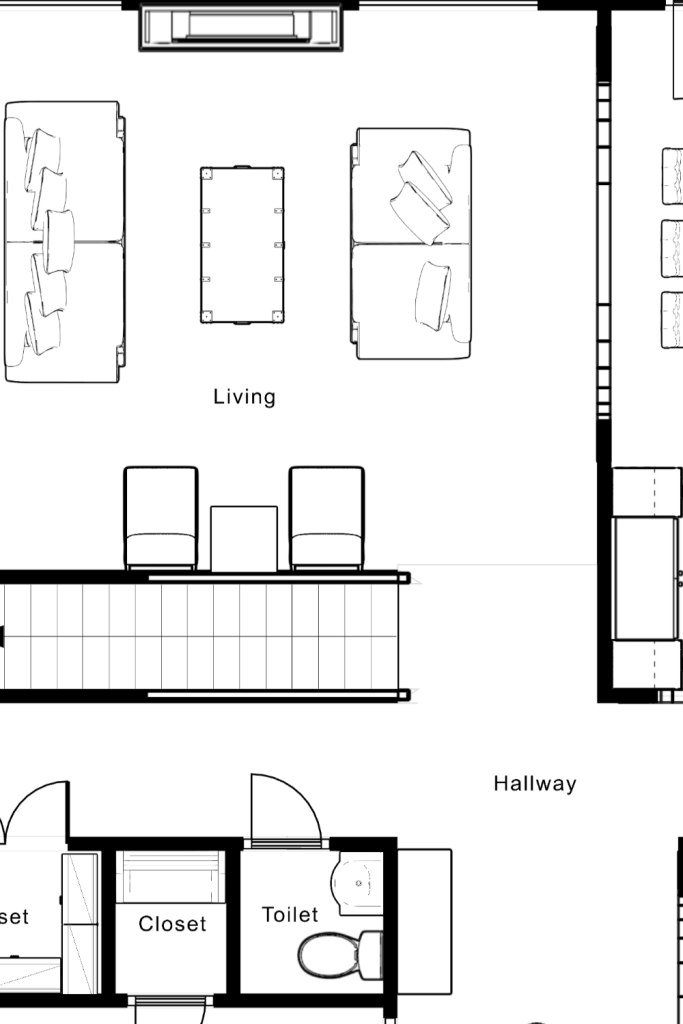
The main thing that we need to adjust when optimizing for flow is layout; how things in a room are oriented and positioned inside of the room. Implicitly, you should also take note of what items you allow in your rooms since their size will affect the layout.
Your goal is to find the best placement in the room for each item, you shouldn’t have to move your hips around a table or squeeze yourself sideways to get through.
If that is happening, move things around.
TIP: You can make the process simpler by removing everything from the room and then moving them back in one at a time, the biggest things first.
This can allow you a better view of how much space is taken up by each item and also allows you to pair down on things if they begin to make the space feel cluttered rather than open.
Remember, we are focusing on more space and better flow, so unless an item holds some sentimental value it would benefit you to keep a loose grip on the items in your home.
If it doesn’t work for the space, don’t force it to be there.
Stuff
The other home improvement meaning does not refer to your home but rather the home for all of your stuff. Specifically, we are talking about decluttering and purging.
Declutter
I’m sure you’ve heard the phrase “everything must have a home” from designers, organizers, and influencers at some point.
Well, they’re right.
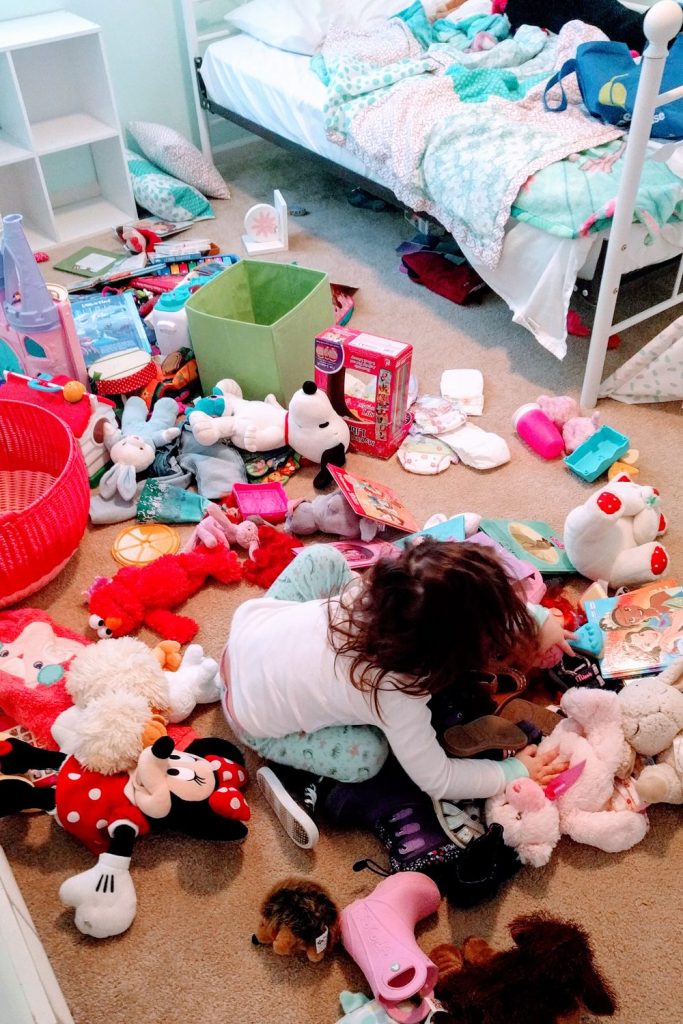
It is not just a catchphrase. Messes, clutter, boxes, and dishes are all stressors that can have a compounded, negative effect on your psyche. So if you are susceptible to stress (that’s all of us) then it’s important to put some effort into decluttering your home.
TIP: Gain yourself some quick wins to boost your motivation by first picking up things that already have a home.
Items like clothes, towels, and dishes normally do have homes like dressers, closets, and cabinets, respectively. Once the obvious stuff is put away it is time to address the squatters.
Start by collecting everything into a single pile and then sorting them into categorically smaller piles.
This gives each “smaller pile” a better chance of sharing the same home, saving you from having to create multiple places for things.
You may still need to find new homes for things that are either awkward in shape, too big, or just don’t seem to fit in everywhere else.
This is where having a “junk drawer” can be handy, but use it sparingly or it can turn into an issue all on its own.
In the end, it is up to you to categorize items and to choose where to put them for the long term so if it takes you a while to get everything settled, that is okay. Just keep at it.
Purge
In your decluttering journey, you may encounter items that are difficult to categorize or determine whether you actually like them. In these scenarios, it’s a good time to ask yourself:
“Do I even need this? Does it bring me joy?”
If you answer “no” to either of these questions, it is the perfect time to start ramping up your decluttering by exploring how to purge your house.
BTW, asking yourself if an item brings you joy or not was inspired by Marie Kondo, she is great!
Not everything in your home deserves to stay there just because it has been there for a while.
This is especially true when you’re working with limited storage space. Only the things that you truly need or the things that make you happy should earn the right to take up valuable space in our homes, everything else can go.
TIP: A good way to keep this process organized is by having two separate containers: “trash” and “donations”. You could even have one for “sellable” items if you want to do that.
These containers should function as temporary collections until you finish purging every room or the containers themselves get too full. They should then go immediately out to the car or into the trash so you can spend more time with the things you actually like.
The ideas in this post were about improving your entire home, not just the physical house.
0 Comments